
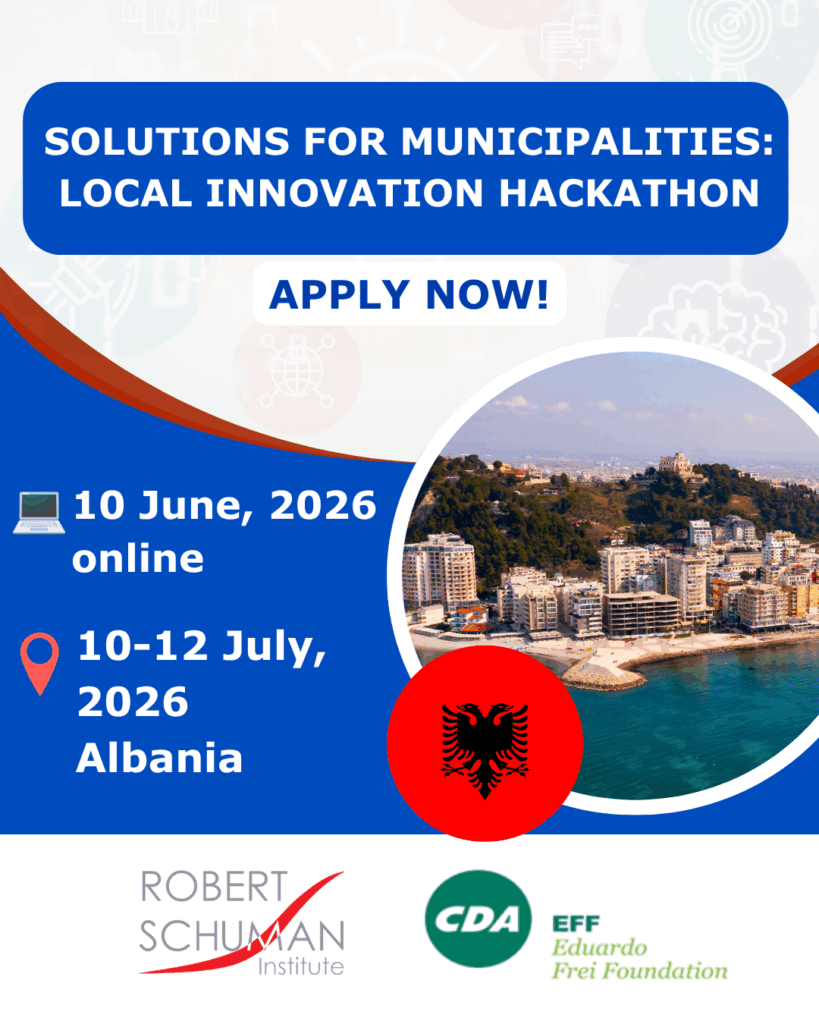
Module 1 (online via Zoom): Wednesday, 10 June 2026
Module 2 (offline, Albania, city to be confirmed): 10–12 July 2026 (Friday–Sunday)
Application deadline: Monday, 8 June 2026, 5 PM CET.
“Want to make a real difference in your community? Join the Solutions for Municipalities: Local Innovation Hackathon and turn your ideas into practical solutions for local challenges. This is more than just a training — it’s an opportunity to collaborate, develop innovative concepts, and create solution prototypes that can improve everyday life in your municipality. Apply now and become a changemaker!”
The Robert Schuman Institute, in cooperation with the Eduardo Frei Foundation, is excited to announce a project designed to empower young center-right political activists and NGO representatives across selected SEE countries.
This year, we are tackling local social and economic challenges head-on by focusing on the development of concrete, impactful solutions for municipalities and communities.
A key element of this project is the introduction of a dynamic hackathon format combined with design thinking (DT), offering a fresh and practical approach to addressing local challenges. These tools will help you better understand the needs of community members, enabling you to design solutions that are both effective and realistic. You will gain practical skills and knowledge in user-oriented problem solving, helping you identify pressing social and economic issues in your community and develop actionable responses. Working alongside other participants, you will contribute to the creation of tangible solution prototypes that offer realistic answers to the most urgent local challenges in your region.
More specifically, we aim to:
Participants: We plan to host up to 16 participants including young center-right municipal councilors, activists, and NGO representatives (aged 20-35) from four Southeast European countries (Albania, Kosovo, North Macedonia and Montenegro). The political parties/organizations and respective communities from these countries will benefit from this project. When recruiting participants, we’ll ensure that partner parties/organisations support our project goals. We’ll select applicants with a proven track record in political/public initiatives, especially policymaking, who are committed to working collaboratively to achieve our program’s objectives!
Working days: Module 1 (online via Zoom): Wednesday, 10 June 2026
Module 2 (offline, Albania, city to be confirmed): 10–12 July 2026 (Friday–Sunday)
Arrival: Thursday, 09 July 2026 (afternoon) – for participants living outside Albania
Departure: Sunday, 12 July 2026 (noon)
Full attendance and active participation in all modules and sessions are mandatory!
Working language: English (no interpretation will be provided)
Structure of the course:
The project will feature one Local Innovation Hackathon cycle based on the Design Thinking (DT) methodology. Two parallel groups (with up to 8 participants in each) will work together to identify local challenges and develop practical, community-oriented solutions that reflect local capacities, available resources, and the municipal context. Participants will collaborate to design concrete ideas and actionable concepts aimed at addressing specific social and economic issues within their municipalities.
This process will be supported through a series of lectures, workshops, group work, and case studies. As part of your group, you will exchange ideas, inspire one another, and provide feedback throughout different stages of solution development and prototyping.
The organizers will cover all program costs, including lectures and full board (hotel accommodation in twin rooms). While we appreciate the participation of local residents, our policy is not to provide accommodation for those living in the city where the event takes place.
Travel costs to and from the venue (including insurance, international transfers, and any additional personal expenses) are the responsibility of each participant. If you have any difficulties in covering international travel expenses, please contact us. We will work with your party/organization to find a solution.
How will it be organized?
Module 1 (online). This module will feature an introductory and team-building session, along with preparatory training for participants. You will receive a general theoretical overview of Design Thinking (DT), the hackathon concept and structure, and an introduction to the overall programme agenda. We will explore social and economic challenges in SEE countries, examining common trends, opportunities, and local realities at the municipal level.
As homework to be completed before Module 2, you will identify and explore key social and economic challenges within your municipality through research and stakeholder mapping. This may include engaging with local actors, community groups, NGOs, existing initiatives, available resources, and relevant local frameworks. You will bring your findings to the orientation session in Module 2, where they will serve as the foundation for group work and solution development. Facilitators will also provide guidance on research methods and practical approaches for gathering and organizing information.
Module 2 (offline). Participants will meet in person in Albania to deepen their practical application of Design Thinking (DT) through a structured, hands-on innovation process. Building on the research completed during Module 1, you will work through key stages of problem analysis, idea generation, solution design, and prototype development.
You will be divided into two subgroups based on your selected thematic focus (social or economic challenges), research findings, and personal interests. Each group will take part in a parallel hackathon track, working collaboratively to develop practical solution concepts tailored to real municipal challenges.
Throughout the process, each group will be supported by a mentor who will provide both theoretical guidance and practical feedback. At the end of the module, the groups will present the outcomes of their collective work “solution prototypes” to a jury panel and receive feedback, evaluation, and recommendations for further development.
Interested applicants should fill in the following online application form by Monday, 8 June 2026, 5PM CET.
Organiser contacts: Robert Schuman Institute
H – 1123 Budapest, Alkotás u. 5.
HUNGARY
Tel: +36-1-202-0000
web: www.schuman-institute.eu
Contact person:
Vladan PAVIC, Project Manager